About Dalit Dignity & Justice Center (DDJC)
The Dalit Dignity & Justice Center (DDJC) was established on 9 October 2023 by the Prayas Jan Utthan Samiti (PJUS) to advance access to justice, constitutional rights and dignity for communities facing caste-based discrimination, violence and social and economic exclusion.
DDJC works at the intersection of law, human rights, social justice and grassroots action. We believe that justice is meaningful only when people can understand their rights, access institutions without fear, and receive fair and dignified treatment from the systems meant to protect them.
Why DDJC is Needed
For many marginalized communities, the formal justice system remains difficult to navigate. Survivors and families may have to move repeatedly between police stations, government offices, lawyers and courts, often without adequate information, legal representation or institutional support.
A lack of legal knowledge, weak institutional accountability, delayed investigations and social discrimination can prevent victims from securing justice. The consequences extend beyond an individual case, affecting families, livelihoods, dignity and entire communities.
DDJC works to bridge this gap. We provide legal assistance, strengthen community legal awareness, document violations, support survivors and engage with institutions to make justice systems more accessible and accountable.
Our work also helps marginalized communities access government welfare schemes and constitutional entitlements, recognizing that access to justice is inseparable from access to social and economic rights.
Justice in a Climate-Sensitive Bundelkhand
DDJC is rooted in Bundelkhand, a semi-arid and historically drought-prone region spread across Uttar Pradesh and Madhya Pradesh. The region is characterized by rain-dependent agriculture, water stress, degraded natural resources and recurring drought. Government and disaster-management assessments identify several Bundelkhand districts, including Jalaun, Banda, Chitrakoot, Hamirpur, Jhansi, Lalitpur and Mahoba, as severely vulnerable to drought.
Climate variability, crop losses and livelihood insecurity have also contributed to seasonal and distress migration. These environmental vulnerabilities intersect with deep social inequalities. Around 25% of Bundelkhand's population has been identified as Dalit/Scheduled Caste, while historical assessments have found more than one-third of rural households living below the poverty line.
Climate stress does not affect everyone equally. Landlessness, insecure livelihoods, caste discrimination and limited access to public resources can leave Dalit and other marginalised communities particularly exposed to drought, livelihood loss and displacement. Women experience these vulnerabilities in distinct and often intensified ways. Caste and gender discrimination can restrict women's control over land, income, mobility, education and public institutions. Women from Dalit and other marginalised communities may also face heightened risks of violence, exploitation and exclusion while having fewer resources to seek legal remedies. For DDJC, therefore, climate justice, gender justice, caste equality and access to justice are interconnected concerns.
Our Mission
To provide accessible and effective legal aid, institutional representation and constitutional awareness to marginalised communities, while challenging the systemic barriers that prevent people from exercising their rights to justice, equality, liberty and dignity.
Our Vision
A fear-free, egalitarian and caste-free India where every person can exercise their constitutional rights and access justice with equality, dignity and liberty.
What We Do
Access to Justice: We support individuals and families in navigating legal and justice institutions and work towards fair, effective and dignified legal outcomes.
Community Legal Empowerment: We conduct village- and panchayat-level awareness programmes, legal literacy camps and community meetings, and help marginalised communities access government schemes and entitlements.
Building Local Legal Capacity: We develop the capacities of first-generation lawyers and panchayat-level paralegal volunteers and community justice champions, enabling communities to better understand and exercise their rights.
Documentation and Research: We document incidents at the district and state levels, undertake ground-level fact-finding, and produce evidence-based research dossiers to strengthen advocacy and institutional accountability.
Legal Aid for Survivors: We provide free legal assistance in cases involving the Scheduled Castes and Scheduled Tribes (Prevention of Atrocities) Act, POCSO Act, domestic violence and other serious violations of rights.
Strategic Legal Representation: We work with a dedicated network of experienced lawyers to support effective advocacy before District Courts, High Courts and the Supreme Court of India.
Rooted in Bundelkhand
Based in Orai, Jalaun, DDJC works across tehsil and district levels, staying closely connected to communities and their lived realities. Our approach combines community engagement, field-based fact-finding, police and administrative follow-up, legal research and courtroom representation. This allows us to respond not only to individual cases, but also to the systemic conditions that produce exclusion and injustice.
We believe that legal intervention becomes stronger when it is rooted in community knowledge, and that lasting social change requires both institutional accountability and community power.
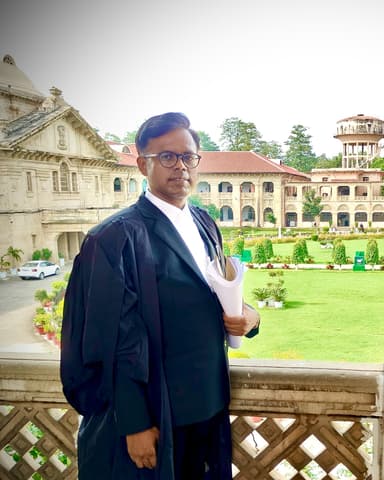
Adv. Kuldeep Kumar Baudh
Founder, DDJC
"Babasaheb Dr. B.R. Ambedkar reminded us that liberty, equality and fraternity must become principles of everyday life. Whenever a person's dignity and self-respect are denied because of caste, our democracy is diminished. DDJC is not doing anyone a favour. We are working to secure the constitutional rights that belong to every citizen. The Constitution guarantees these rights; our responsibility is to ensure that they reach those who have been historically denied them. Leave fear behind in the journey towards justice. We stand with you."